رنج [RANJ] CUTTING TOIL
There is a kind of suffering that one can go through that is deeply cutting, wounding, burning, troubling, torturous even — and yet we voluntarily sit through or even ask for it at some moments in life. It sounds strange, to want to engage with something that painful and disturbing. And yet, all of you who have read this have probably have some memory of a passionate a love affair at some point in your life, where ranj is part of its very fabric. Or perhaps you have had a loved one go through a difficult surgery. These are two very different examples but in both, one emotional the other literally of the flesh, we accept or even ask and pay for this kind of suffering, not because we are masochistic and glorify pain, but because of our commitment to life.
And here is where this other aspect to ranj comes in, which makes this such a profoundly fitting word for our feelings these days as Iranians. That is its implication of toil; to strive, work, suffer for something. Ranj is not merely suffering, but it is a form of cutting toil we go through to endure the pain for something we love.
I had just published my previous essay on the immensity of the grief and the Iranian experience after the massacres in Iran on January 8 and 9 of Iranian citizen by the Islamic Republic occupying Iran, when Israeli/US bombs started dropping on our beloved homeland. Now this essay will be one of the most complicated ones I have written, because it is not your usual war-essay. But despite being partly in paralysis myself, I am committed to the ranj of writing this piece. Not because I am masochistic only, but because I have received overwhelming amounts of messages and voice notes from Iranian friends and family in the diaspora trying to explain to their non-Iranian friends what we are going through.
To make this humanly relatable and pull it out of the disorienting, sticky web of geo-politics for just one moment so we can breathe together, I will start with a personal story.
The Suffering Mother(land)
It was now 12 years ago that I watched my mother go into the hospital for her first chemotherapy. It is one of the strangest experiences, some of you may have experienced this yourself. It is hard to describe that feeling: worry, dread, hope, a sinking horror, grief, suspension, and a sense of being deflated, abandoned by the ordinary of this world that just carries on as usual as you have to watch the apocalypse unravel in your loved ones’ body. You are here, but your feet are only lightly touching the ground and yet you hold onto dear everyday life for some sense of normalcy. You hold onto it not only out of self-caring survival reasons, but as an act of resistance, as hope in action – that life will triumph over looming of death.
It is a strange thing to have to sign for this violent destructive thing that is chemo to be done to the body. But you know you are both going through this ranj, this torturous suffering, in the hope for life to continue, not for the destruction of chemo to triumph in your loved one’s body. Those of us that grew up with holistic remedies, or plants as healing agents had another layer of dread added to this ranj because somewhere, we did not “believe” to this type of treatment. This was also part of me, because my mother was a source of the healing arts herself. She raised me with my body firmly rooted in the ancient Iranian herbal and “attari” tradition. She would give me a mixture of herbs and acupuncture treatment when I would be in pain instead of a pill to pop. Seeing her then go through something as violent and destructive as chemotherapy was not much different than seeing the body of my beautiful Iran now be bombed by the US and Israel.
It is quite frankly, the exact same feeling.
I do not “believe” in wars, in bombs, in destruction, in mechanical violence. I do not wish that on anybody, your people or mine. I do not celebrate destruction. And most certainly, I do not praise dictators, whether they are in a cleric gown or suit.
But, I do know in the sheer desperation of a body faced with imminent death risks of cancer, and I do know the sheer desperation of a people asking to be bombed as their final, desperate hope for a life with some dignity and freedom.
When you have just seen your own people slaughtered, yet again, before your very eyes in the tens of thousands in just 48 hours, when you have seen brains blown up and blood in the sidewalk of your beloved neighborhood, when you have seen mothers wailing and grieving, pulling their hair, scratching their face, dancing, stamping, screaming on their children’s graves, when you have heard testimonies of protesters that were arrested tell you about forms of torture and rape that make you want to scream so loud that you make yourself deaf to the darkness of humanity, then, perhaps you too, might understand a people that ask their country to be bombed. You might understand that they will sit through the ranj of the destruction of war, in the hope for a living future.
Or perhaps you might not.
Just like my mother did not choose to go to chemotherapy again when the cancer was back a few years later. And I stood behind her, with some doubt, but I stood. I hoped, again, this time not in the hospital but in her pursuit through all kinds of health and spiritual avenues to find healing. This was a different kind of ranj, it was less brutal in the beginning, but a hundred times more painful and confusing with the passing of time.
Here I am, almost 10 year after I saw her frail broken body wrapped in a white shroud descend into the soil of Iran, and I often wonder if she was too naïve to think she could beat cancer with bear hands.
I think she was. But I still respect her decision, to live in the way she did and to die in the way she did.
Perhaps that is the best we can come to. We might not always understand someone’s, or a nation’s choices, but we can learn to respect them. If you are not Iranian, you probably cannot fathom why so many Iranians are asking for this war/intervention/regime change (however you want to call it). But perhaps you can respect their decision, let them have their lived experience, because quite frankly – I don’t know what it feels like to have cancer in my body. And I do not wish to know what kind of ranj my mother went through, just like you really do not wish to know what ranj we Iranians have went through the past 47 years seeing our homeland, its best people, nature, recourses and animals be raped and killed through annihilating terror. And I certainly do not wish for you to know what we are going through seeing the body of our homeland be bombed all the while holding on to the hope (perhaps naïve, perhaps not) that this destruction will bring new life to the broken body of the jewel that is our Iran Banoo (Lady Iran).
I will end this essay with the words of Ghazal, who knows what it means to suffer ranj like many other Iranian women and men who gave their flesh, bone, blood, eyes, limbs for a glimpse of the freedom and life that you take for granted every day living outside of a dictatorship:
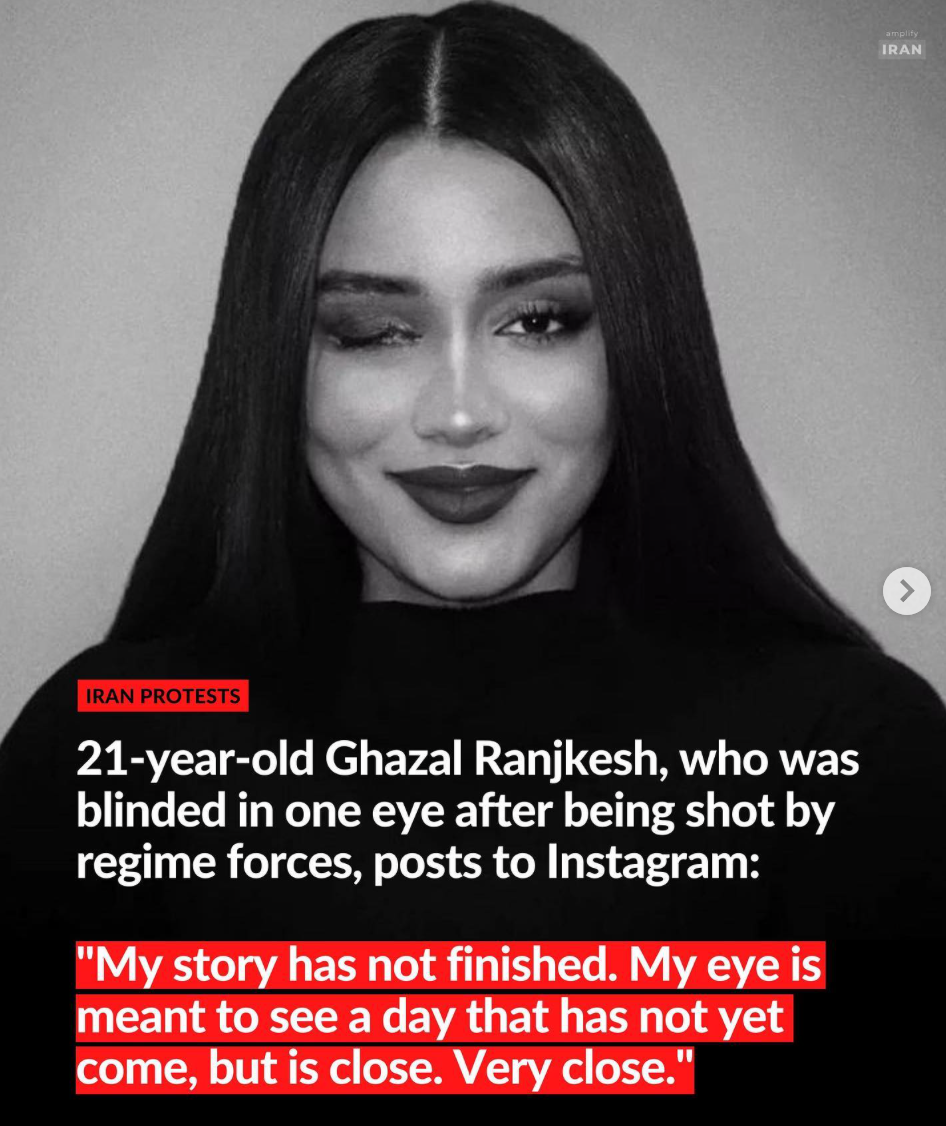
Ghazal Ranjkesh (meaning: one who endures ranj) was blinded in one eye like 500+ protestors during Woman Life Freedom uprising in 2022, when Gen Z rose up to demand justice and freedom after the killing of Mahsa Amini by the “morality police” for showing some of her hair.